State Space Models

All state space models are written and estimated in the R programming language. The models are available here with instructions and R procedures for manipulating the models here here.
Showing posts with label Russia. Show all posts

Friday, September 5, 2025

World-System (1960-2100) A New "Axis of Evil"?


On September 1, 2025, in the Chinese port city of Tianjin, Chinese President Xi Jinping held a summit in response to the Trump II Administration tariff policies that included leaders of Russia and India and other representatives from the Global South (here). Xi declared that "Global governance has reached a new crossroads," in the fight against US Hegemonic Power. Did Xi just announce the birth of the New Axis of Evil? And, what might this mean for the future?

The conclusion from my World-System models is that the future forecasts for the New Axis of Evil all lead to collapse of the system (except for one worrisome scenario).

In prior posts (see the Notes below), I have looked at the issue of US Hegemonic Dominance and the economic performance of Russia, India and China. In this post, I will look specifically at how the three countries (RU, IN and CN) could interact with the current World-System.

The Measurement Matrix (see the Boiler Plate for more information about Dynamic Component Models) is presented in the Notes below. In terms of overall growth, the first growth components for each country are relatively equally weighted (AXIS1). The historical feedback controller (AXIS2) is dominated by Russia. From the graphic above, Russia's dominance peaked before 1990 and then decline after the Fall of the Soviet Union.
--


For the late Twentieth Century, the system was dominated by the US. If that domination were to continue until 2100, the AXIS System would collapse--pretty strong motivation for eliminating US influence.


If the AXIS System were to align itself with the World-System (graphic above), the forecast for the future is also collapse.


If the AXIS System were to go it alone (as a BAU System), the countries could grow exponentially but it would involve the decline of the Russian historical feedback controller (AXIS2) -- a loss that would probably not be tolerated by Russia.


Unstable exponential growth will not minimize Environmental Damage from growth, so another option for an AXIS system not dominated by Russia is to stabilize growth (graphic above). Stability leads to a steady state after 2100 but would also probably not be tolerated by the AXIS participants.

In summary, none of the Geopolitical Alignments for the AXIS System look very promising. Either the system will eventually collapse or it's reason for existence (unending exponential growth) will not be consistent with World System Balance.

However, pursuing World System Balance does not seem to be a priority of any potential Hegemonic or Multipolar Leaders in the World-System.  In the Functionalist explanation, the AXIS System is necessary for the military-fueled expansion of all the participants .I will investigate the AXIS BAU scenario in a future post (here).

You can run the WL20_AXIS model here, the WL20_RU model here, the WL20_CN model here and the WL20_IN model here

You can run the AXIS_of_Evil models here.

Notes

Other relevant postings:


Thursday, July 31, 2025

World-System (2015-2100) US Attempts to Dominate India


Reuters is reporting (here) that the Trump II Administration is planning to impose 25% Tariffs on India and, not surprisingly, creating Political Chaos in India. My first question is "What is really going on here?" Trump's Trade War makes little economic sense and is opposed to conventional Republican Right-Wing Free-Market Ideology.

If Trump's Trade War isn't about Economics, what is it about? My best guess (and there might not be a rational explanation) is that the Trade War is about Political Power. Trump is intent on the Economic Domination of every country in the World-System and has decided that a Trade War is the way to do it. And, right now, he seems to be winning--most countries appear anxious to capitulate. How the Trade War helps Trump personally or the US Economy, if at all, remains to be seen.


Another (and maybe more important questions) is what kind of Geopolitical Alignment is best for India (or any other country, for that matter)? In terms of the models I have estimate, the World-System Linkage model (W)** is the best for India [-99.33, AIC=-60.09, -28.39]*** while in terms of predicted performance, the BAU model [-9.571, AIC=26.53, 57.61] is best (graphic above). In the long-run, US domination will lead to collapse of the Indian Economy (I would assume that the Trump II Administration isn't thinking this far ahead).

Russian domination (RU) is another interesting case. Russia is itself a cyclical economy (think of the Collapse of the Soviet Union) and that cyclicality would be transmitted Geopolitically to India. There would be periods of success and periods of failure.

In the end, my guess is that Indian (and any other country, really) would prefer the BAU model, that is, to be left alone to find their own attractor path

You can experiment yourself with the IN_LM_BAU model here. You can learn more about how the models were constructed in the Boiler Plate. For more discussion of the Indian Economy, see India as a Small Regional Economy.


Notes

** Other types of Geopolitical Alignments estimated in my models are discussed in the Boiler Plate.

***Akaike Information Criterion (AIC) Smaller is better.

The BRICS (of which India is a member) are actually an intergovernmental organization of ten countries but the name comes from just five: Brazil, Russia, India, China, South Africa. You can experiment with the BRICS BAU state space models on the following sites:
  • Brazil (BR_20 Model) An unstable model that leads to collapse (stabilizing the model also leads to collapse). There are strong historical unemployment and environmental Controllers. See if you can find a steady state for this economy!
  • Russia (RU_LM Model) An unstable model with strong Export-Employment historical controllers. Becomes cyclical when stabilized.
  • India (IN_LM Model) A Malthusian Economy currently in collapse mode. Stabilizing the economy is beneficial.
  • China (CN_LM Model) An unstable economy with strong historical Export-Employment controllers. Stabilizing the economy produces a steady state after 2100.
  • South Africa (ZA_20 Model) An unstable economy with strong Globalization-Environmental historical controllers. Stabilizing the economy would lead to a steady state in the distant future (well after 2100).

The BRICS are not a uniform set of Semi-Peripheral countries. They have different dynamics and different historical patterns of development. Neoclassical Economics makes a mistake when applying the same Exogenous Growth Model to these countries.

Trump doesn't think much of either the Indian or the Russian economies (here) and calls them "dead economies". Obviously, the Trade War is not meant to help other countries in the World-System but rather to dominate them (read more about Trump's Trade War here from a World-System Perspective).

Thursday, June 12, 2025

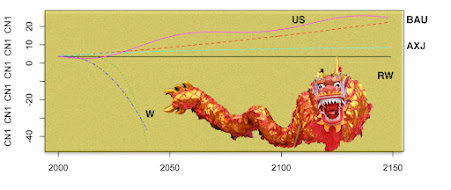
World-System (2000-2100) Six Futures for China, One Scary


Most Geopolitical Alignments are mildly beneficial, except for alignment with the World System which is not. The order of benefits (in terms of comparison to a Random Walk, RW) are Asia Region (AXJ), Business as Usual (BAU, no alignment) and United States (US). 


One forecast missing from my standard forecasts (and the most concerning) is the one involving Geopolitical Alignment between Russia and China. Although the alignment has been publicly proclaimed by each country, there is increasing concern about CN intelligence activities in Russia (here). For more information about China-Russia relations, see the Wikipedia page (here).

I will investigate Global South alignments for China in a another post here. For more information about how the statistical models were constructed and estimated see the Boiler Plate.

Notes

Excerpts from ChatGPT:

Thursday, December 19, 2024

World-System (1980-2060) Five Futures for Russia (one surprised me)


Now that the Syrian Regime has collapsed (here), questions about what the collapse will mean for Russia are begin discussed (here). Russia did not intervene when rebels overran the Syrian capital and the question is "why" given that Syria fought not be become a Russian puppet state (a topic I will cover in a future post). In this post, I will concentrate on some possible future geopolitical alignments for Russia, one of which is to go it alone (BAU). One of the interesting and controversial models is to link to the EU, which would be by far the best choice for Russia, the least likely to happen in the medium term future and certainly the least discussed openly right now.

The graphic above presents five futures for Russia based on the RUL20 model (here):

  • BAU The Business As Usual model is unstable and cyclical (you can run the model yourself here). BAU is a fairly good model but not the best model (91.26 < AIC = 130.2 < 163.5). Unfortunately, the BAU model encourages military expansion because currently Russia needs Ukraine to prevent a Malthusian Population Crisis (to be covered in a future post).

  • RW The Random Walk model would be best interpreted as a descent into Chaos, today being like tomorrow except for random shocks. The RW is actually not a bad competitor model for Russia (110  < AIC =  128.9 < 147.3) and may be quite likely if Russia looses the War in Ukraine.

  • W Rather than isolating itself (BAU model), the World Linkage model assumes that Russia becomes an Open Society with Political and Economic links to all countries in the World-System (right now, Russia is a Semi-peripheral authoritarian country trying to become a Core country through military force). The W-Linkage model is not a very good competitor (126.4 < AIC = 155.6 < 190.1) and retains the unstable cyclical nature of the Russian System.

  • US Linking to the US has never been seriously pursued in Russia, although the Glasnost period in the 1980s is about as close as the two countries came (67.98 < AIC = 114.3 < 150.7)--maybe because it would lead to cyclical collapse for Russia. 

  • EU Russia joining the European Union (EU) is, to me (somewhat surprisingly), the best option (of the models considered here) for Russia (58.25  < AIC =  102.2 < 144). It would allow Russia to continue growing exponentially and benefit from trade with the EU (particularly oil, natural gas and agricultural trade with Ukraine). Maybe this dream scenario will happen at some time in the distant future, but I am not holding my breath.
There are certainly many other futures for Russia, but the graphic above seems to bracket the options from continued exponential growth to collapse. Let's just assume that Business as Usual with continued military expansion is, at least in the short run, the best prediction. To me, since the BAU model is cyclical and in the process of heading for a downturn (as of 2024), the best response would seem to be to keep supporting Ukraine and allow Russia to continue on the path of cyclical downturn. This does not seem to be the preferred path of the New Trump Administration in the US, starting in 2025.

Notes

Data taken from the World Development Indicators (WDI). All variables are in standard scores. The methodology used to create forecasts is similar to the one used by the Atlanta Federal Reserves GDPNow app. Prediction intervals are generated using a Bootstrap algorithm in the R programming language. The Akaike Information Criterion (AIC) is used for model selection.

You can run the RUL20 BAU Model here. You can change any coefficients in the System Matrix, F, to see what effect your changes will have on the system. Reasonable counterfactual values can be determined from the coefficient bootstrap confidence intervals:


LCI is the lower confidence interval and UCI is the upper confidence interval. In probability, the system can clearly be stabilized.

You can also run the EUL20 model here.

There is a small cottage industry of articles on Russia's Future many of them envisioning "Five" futures. Most of the articles are behind paywalls but here is one you can read from Casey Michel at The Atlantic Coouncil.