State Space Models

All state space models are written and estimated in the R programming language. The models are available here with instructions and R procedures for manipulating the models here here.
Showing posts with label China. Show all posts

Friday, May 15, 2026

East-Asia Pacific: Alternate Futures


May 15, 2026 Trump-Xi summit ends on cordial note but no breakthroughs ... - CNN

President Trump seems attracted to the old idea of Spheres of Influence when pursing Geopolitical Alignments. Critics argue that the idea is useless, at least for the US and China in the 21st Century. But President Trump presses ahead, leaving Europe and NATO while focusing more directly on Latin America. The idea seems to be that China's Sphere of Influence would naturally be the East-Asia Pacific Region (EAP). In this post, I use the EAP_L20 Model to ask what type of Geopolitical Alignment (if any) would be best for the people of the Indo-Pacific.

All of the Geopolitical Alignments for the EAP Region are unstable (except with China) while alignment with China (CN) produces rapid growth-and-collapse out to 2100.


In other words, allowing CN to assert it's Sphere of Influence over EAP would produce growth and stability benefits for the Indo-Pacific. China, however, does not seem to be interested.


Notes

Measurement Model


AIC Statistics


EAP_L20 Model CN Input


Thursday, September 25, 2025

World-System (1970-2100) Latin American Futures


The Trump II administration, which took office in January 2025, is threatening to impose tariffs on Latin American Countries. In turn, the Latin American Countries are threatening retaliation on the US (here). Rather than investigating whether this trade war is a good or bad thing, let me take a broader look at Latin America's future from the perspective of Geopolitical Alignment (I'll look at Mexico, Venezuela, Columbia, Panama, etc. in future posts).


Latin American faces a wide range of futures from unlimited exponential growth if aligned with China (CN, in the graphic at the beginning of the post) or collapse if aligned with the World System (W). But, let's take China out of the picture (assuming the US would resist such a future). The graphic above shows the "also ran" input models:
  • BAU The Business as Usual model (which you can run here) is cyclical but has the best growth out to 2100. 
  • TECHE The Technical Efficiency model is stable and a strong contender (AIC = -160.3, smaller is better). 
  • TECHP The Technical Productivity Model is also stable and has one of the best statistics (AIC = -264.3). This model is the Systems Theory analog of the Neoclassical Economic Growth Model with exogenous technological change.
  • US The model driven by the US is also stable, cyclical and an obvious contender given the history of Latin America (AIC = -85.96).
  • RW In the short run, the Random Walk is a strong contender (AIC = -108.1).
  • W The World System input model is stable, cyclical and also a strong contender (AIC = -71.53). Unfortunately, it leads to collapse starting in the very near future.
You can experiment with the LA20 BAU model here. Instructions for modifying the model to produce stable and/or cyclical patterns are given in the code. I believe that the BAU model describes how policy makers think about their own economy, regardless of what Systems Theory right tell them about "Best or Worst Models" (an important Contradiction).

You can read about data sources and how the State Space models were created in the Boiler Plate.

Notes

LA_SYS Model Summary with AIC (Akaike Information Criteria) Statistics:


Friday, September 5, 2025

World-System (1960-2100) A New "Axis of Evil"?


On September 1, 2025, in the Chinese port city of Tianjin, Chinese President Xi Jinping held a summit in response to the Trump II Administration tariff policies that included leaders of Russia and India and other representatives from the Global South (here). Xi declared that "Global governance has reached a new crossroads," in the fight against US Hegemonic Power. Did Xi just announce the birth of the New Axis of Evil? And, what might this mean for the future?

The conclusion from my World-System models is that the future forecasts for the New Axis of Evil all lead to collapse of the system (except for one worrisome scenario).

In prior posts (see the Notes below), I have looked at the issue of US Hegemonic Dominance and the economic performance of Russia, India and China. In this post, I will look specifically at how the three countries (RU, IN and CN) could interact with the current World-System.

The Measurement Matrix (see the Boiler Plate for more information about Dynamic Component Models) is presented in the Notes below. In terms of overall growth, the first growth components for each country are relatively equally weighted (AXIS1). The historical feedback controller (AXIS2) is dominated by Russia. From the graphic above, Russia's dominance peaked before 1990 and then decline after the Fall of the Soviet Union.
--


For the late Twentieth Century, the system was dominated by the US. If that domination were to continue until 2100, the AXIS System would collapse--pretty strong motivation for eliminating US influence.


If the AXIS System were to align itself with the World-System (graphic above), the forecast for the future is also collapse.


If the AXIS System were to go it alone (as a BAU System), the countries could grow exponentially but it would involve the decline of the Russian historical feedback controller (AXIS2) -- a loss that would probably not be tolerated by Russia.


Unstable exponential growth will not minimize Environmental Damage from growth, so another option for an AXIS system not dominated by Russia is to stabilize growth (graphic above). Stability leads to a steady state after 2100 but would also probably not be tolerated by the AXIS participants.

In summary, none of the Geopolitical Alignments for the AXIS System look very promising. Either the system will eventually collapse or it's reason for existence (unending exponential growth) will not be consistent with World System Balance.

However, pursuing World System Balance does not seem to be a priority of any potential Hegemonic or Multipolar Leaders in the World-System.  In the Functionalist explanation, the AXIS System is necessary for the military-fueled expansion of all the participants .I will investigate the AXIS BAU scenario in a future post (here).

You can run the WL20_AXIS model here, the WL20_RU model here, the WL20_CN model here and the WL20_IN model here. 

You can run the AXIS_of_Evil models here.

Notes

Other relevant postings:


Friday, June 13, 2025

World-System (2000-2150) China and the Global South


In a prior post (here), I looked at China's possible Geopolitical Alignments, first with the World-System and then with Russia. In this post, I look at China's possible Geopolitical Alignments with the Global South. In the long-run, alignment with Latin America (LA) would clearly be in LA's interest; Africa (AF), not so much.

Thursday, June 12, 2025

World-System (2000-2100) Six Futures for China, One Scary


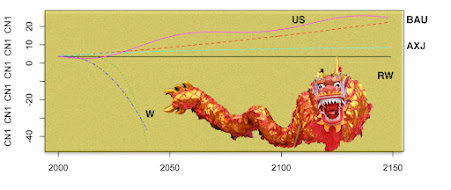
Most Geopolitical Alignments are mildly beneficial, except for alignment with the World System which is not. The order of benefits (in terms of comparison to a Random Walk, RW) are Asia Region (AXJ), Business as Usual (BAU, no alignment) and United States (US). 


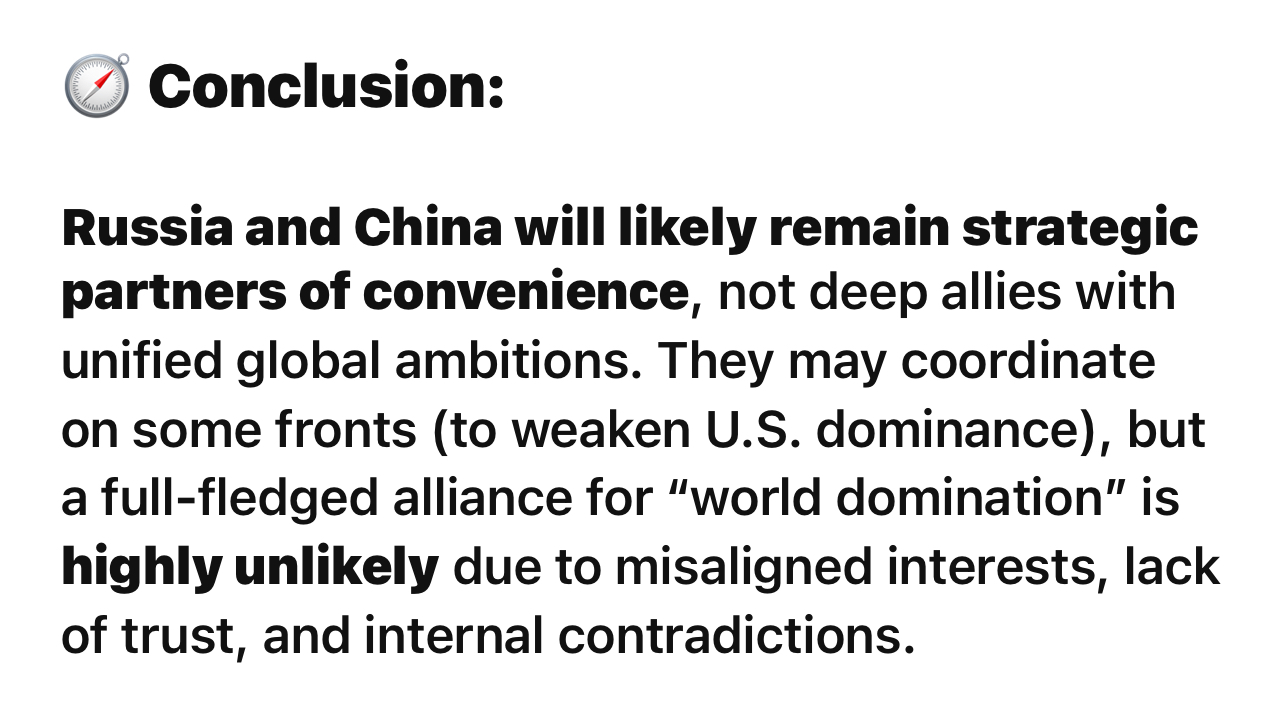
One forecast missing from my standard forecasts (and the most concerning) is the one involving Geopolitical Alignment between Russia and China. Although the alignment has been publicly proclaimed by each country, there is increasing concern about CN intelligence activities in Russia (here). For more information about China-Russia relations, see the Wikipedia page (here).

I will investigate Global South alignments for China in a another post here. For more information about how the statistical models were constructed and estimated see the Boiler Plate.

Notes

Excerpts from ChatGPT: