State Space Models

All state space models are written and estimated in the R programming language. The models are available here with instructions and R procedures for manipulating the models here here.
Showing posts with label France. Show all posts

Wednesday, October 15, 2025

World-System (1980-2100) Will Political Instability Hurt the French Economy?


Recently, the NY Times reported (here) that "...after three government upheavals in France since last summer, the damage to the French economy has already been done." In this post, I will take a look at the data. Recent data on French GDP comes from the World Bank and ends in 2024. The graphic above shows French Real GDP (GDP in constant 2015 US$) with a forecast and 98% confidence intervals out to 2100. 

French GDP is forecast to grow until about 2045 and then collapse after that. 

In terms of "damage to the French economy," the 2020 COVID-19 Pandemic was a major shock (outside the lower 98% confidence interval). In 2024, French GDP was a bit above the forecast attractor path (dashed red line). Political turmoil might reasonably be expected to bring the economy back to the attractor path but not create another COVID-style shock.

Possibly the most concerning aspect of the GDP forecast is the collapse starting around 2045. Why is the French Economy forecast to be in Growth-and-Collapse mode?

If you have been following my prior postings on the French Economy (here) you will see that France is approaching a Steady State Economy (maybe).*** French GDP, on the other hand, is best predicted by the World System (see the Notes below), which is in growth-and-collapse mode (see the WL203 Model). To avoid this future, some geopolitical re-orientation** will be needed.

Looking at the AIC statistics (below). One approach would be to reorient the French Economy to Business as Usual (BAU, [16.16 <  AIC =  21.38 < 25.79]) with no external geopolitical alignments, which produces the steady-state forecast above.  Compared to the World System model (W, [-97.78 < AIC =   -46.24 < -9.145]) which has the best AIC, this will require some geopolitical work. One path would be through the Random Walk (RW, [ -67.1 <   AIC =  -56.52 < -47.09]) which has a very good  AIC but is not predictive of the future.

One charitable analysis of current French Political Instability is that it is part of a Random Walk walk process to find a different Geopolitical Alignment. There is no guarantee that the process will end in a Steady State Economy.

You can experiment with the FRL20 BAU model here and explore alternative futures.

Notes

** The New York Times also reports (here) that France's ability as a geopolitical actor has been compromised by the current Political Instability.

*** The issue surrounding unending (exponential, unstable) Economic Growth, Limits to Growth, Steady State Economies,  and Growth-and-Collapse Modes have been uncovered (again--the debate has been ongoing since the 1970s) in the 2025 Nobel Prize for Economics. Joel Mokyr, a historian and one of the recipients, argues (here) that a Steady State Economy where growth has ended is unlikely. If history is any guide, new innovations will always break the Steady State and create more opportunities for growth. However, see my discussion of French Technology Cycles here and here. Also see Joseph Schumpeter's Creative Destruction model (here). I will review all these models in a future post, but as an obvious summary: no one knows the future. I can only report on forecasts from models and wait to see what happens to the actual French Economy.

AIC Statistics


Technology Models

The Nobel Price in Economics was recently award to Phillipe Aghion, Peter Howitt and Joel Mokyr for their work on How Technology Drives Economic Growth. Reviewers have claimed that their work has relevance for current Growth Policy. For this post, I can just point out that the two technology input models, TECHE (TECH Efficiency) and TECHP (Tech Productivity) are reasonable competitors but not the best models.

An interesting point is that the Aghion-Howitt model with Creative Destruction defaults to a Random Walk (RW) with drift.

I will investigate La French TECH in a future post (here).


Wednesday, September 10, 2025

World-System (1975-2150) Breaking Cycles of Austerity in France


The background graphic above was from a protest in Aug 2012 (you can see the small peak in AUST1--see the Operational Definitions in the Notes below--in the overlay time series plot). Emmanuel Macron took office in 2017, right after AUST1 hit bottom. His government has been riding the AUST1 Recovery wave since then. From my Business-As-Usual (BAU) model of French Austerity (here), AUST1 can be expected to peak in the next few years and decline after that. However, the decreasing Cycles of AUST1 will continue well past 2150. 


The BAU model, however, is not the best model for French Austerity. In the long-run, AUST is better seen as being driven by the EUL20 model (which is also steady state). In future posts, I will look at Austerity in the European Union (EU). In the short run, the best model is a Random Walk (RW)--validated by the Macron Administration's inability to form a government and retain a Prime Minister. The attractor path for the RW model is presented above (dashed red line). The RW attractor path suggests that AUST1 should be kept at a low level aside from random movements.

Austerity is a difficult component of Neoliberal Theory (see below). Especially, the dominant controller, AUST1, depends on external forces such as US Military support and the Russian-Ukrainian War which is forcing military expenditure up and creating the budgetary crisis with Health, Education and Welfare.

For an understanding of why Austerity has become such an issue in France, keep in mind that the Economy of France is becoming a Steady State Economy (see the FRL20 Model). One interesting hypothesis is that cyclical processes such as Austerity become more important as the system reaches a steady state and the dream of unending exponential growth (Techno-Optimism) is over. Promises can no longer be made that growth will solve Social Inequality problems. The New Axis of Evil can be used to motivate increased military expenditure but, to avoid reducing Social Expenditure, Debt will have to be used to drive the economy, creating another focus for Protest and wide-spread civil unrest.

You can experiment with the FR_AUST model here. For more information about how the models are constructed see the Boiler Plate.

Notes

More reading:


Austerity, as a theoretical concept, is part of Neoliberalism (see the graphic above and Shefner, 2015 here and here). I will explore the other aspects of French Neoliberalism in future posts.


The data for the AUST index is taken from the World Development Indicators (WDI). The indicators and definitions are listed in the table above. NOTE: AUST is entirely measured by budgetary categories as percentages; the cyclical nature of the index is a result of percentages hitting up against limits [0%,100%].


The AUST index contains three components that explain 94% of the variation in the indicators. 

AUST1 = (0.433 GED + 0.4571 MIL - 0.4477 G - 0.393 GE - 0.4701 GH)  
AUST2 = (0.822 GHE - 0.357 GED - 0.377 GE) 
AUST3 = (Overall Growth) 

AUST1 and AUST2 are historical feedback controllers for the budgetary categories defining Austerity. AUST1 focuses on controlling Education, Military expenditure, Overall Government Expenditure and Health Expenditure. AUST2 focuses on controlling Health and Education Expenditure.


In the Economy of France, Austerity, Debt and Globalization (KOF) are closely related. The relationship can be seen from the Measurement Matrix above when DEBT and WorldGlobal (KOF) are added to the model. In future posts, I will investigate all the indicators of Neoliberalism in France.


The state space of the French Economy is dominated by three components explaining 98% of the variation in the underlying indicators: 

FR1=(Overall Growth)
FR2= (CO2+EF-KOF)
FR3=(LU-L-N

FR2 and FR3 are Historical Feedback Controllers regulating Environmental Impacts of Globalization and Unemployment, respectively. EF is the Ecological Footprint and KOF is the Index of Globalization.

You can run the FRL20 Model with code available in Google Sites.


Thursday, December 5, 2024

World-System (1980-2100) Six Futures for France

The New York Times (here) is reporting that the recent collapse of the French government will "...further burden its weak economy" and have ripple effects across Europe. The analysis, however, might be confusing cause and effect. Weakness in the European Union (EU) economies, to include France, might be creating the observed political instability. What I want to explore, starting with France, is whether we are observing the emergence of Steady State Economies in the EU, and that this should not be confused with "weakness". Business commentators and economists, at least in the US, seem convinced that economies can grow forever or, at least, for the foreseeable future. For example, the DICE model (a neoclassical integrated assessment model) grows forever unless a limit is put on technological change. So, it is no surprise that the FR20 (France Twentieth Century model, the dashed blue line marked FR) driven by the US Economy grows forever (dashed red line marked US in the graphic above). Unfortunately, for neoclassical economic theory, this is not the best description of the current French economy using the Akaike Information Criterion (AIC).

Three other models, the Random Walk (RW, dashed blue), the Business As Usual (BAU, black line) and the EU model (right beneath it) are probably what classical economists would identify as the Steady State Economy. Growth reaches an asymptote around 2100. Finally, the FR20 model is driven into collapse mode by the World System (dotted green line).

If you prefer central tendencies in your forecasts, then you probably would conclude that the Steady State Economy is the most likely future. If you are a techno-optimist, you will probably prefer the US-driven future. If you are a Degrowth advocate, you will probably prefer the FR or the W scenario.

Without committing myself to some unknowable future, it seems clear to me that the steady-state and collapse scenarios will not be accepted without resistance. Demonstrators will take to the streets, governments will fall, right-wing political groups will grow in appeal and we will enter a period of chaos. Maybe this is why the Infinite-growth scenario is so appealing.


Notes

FR1 is the dominant state variable of the FR20 system with data taken from the World Development Indicators (WDI). The methodology used to create forecasts is similar to the one used by the Atlanta Federal Reserves GDPNow app. Prediction intervals are generated using a Bootstrap algorithm in the R programming language.

The FR1 state variable was created from the following weighted indicators (the first row of the Measurement Matrix) and explain 98% of the variation. 


The first six indicators in standard scores are taken from the World Development Indicators (WDI). KOF = KOF Index of Globalization, EF = Ecological Footprint, HDI = Human Development Index. The second two components: FR2=(CO2+EF-KOF) and FR3 = (LU-L-N-HDI) describe environmental and Unemployment Error Correction Controllers (ECCs).

You can run the FRL20-BAU model here

Wednesday, December 4, 2024

French Debt, Collapse of the Government and COVID-19, World-System (1950-Present)


Le Monde (here) is reporting that, after a vote of no-confidence, the coalition government of Emmanuel Macron is about to collapse. Earlier this Summer, Macron had called snap elections in which he did not get enough votes to retain power without forming the coalition government. Now that government has fallen, supposedly over the problem of Central Government Debt.

The graphic above displays the shocks to the (Q-DEBT) error-correction controller that triggered the collapse. The 2020 COVID-19 shock initially decreased (Q-DEBT) as the economy contracted, but after that DEBT increased dramatically to deal with COVID-19 and stimulate the economy. The effects of the COVID-19 shocks are still with us even though the media seems not to highlight the connection.


Debt has been a problem in the European Union (EU) since the  European Sovereign Debt Crisis from 2010 through 2024 (which can also be seen clearly in the graphic at the beginning of this post). Debt is a problem in the EU since states do not control their own currency and cannot print Euros when needed. Modern Monetary Theory (MMT) suggests that the Euro-zone single currency is at the root of the problem. 

If the currency-inflexibility problem is not resolved, the forecast for (Q-DEBT) in the graphic above is for increasing problems, especially when future shocks create instability.

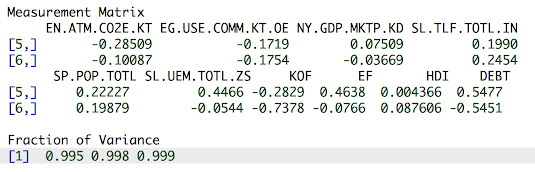
One question you might have is how important DEBT is to the French Economy. If we include DEBT in the Measurement Matrix (below) is doesn't become important until the Fifth and Sixth components and explains under 0.3% of the variation.


The two debt components, FR5 and FR6, capture the (DEBT+Unemployment+Ecological Footprint-KOF Globalization) and (L+KOF-DEBT) controllers, respectively.


The time plots of FR5 and FR6 (above) suggest that the two components are random walks being thrown around by shocks. To me, the results says that the Political System is mostly preoccupied with chaotic components that can be leveraged for political advantage. I discuss the future path of the FR dominant components here.

Notes

Q =  NY.GDP.MKTP.KD, DEBT = GC.DOD.TOTL.GD.ZS,  both from the World Development Indicators (WDI). All variables are in standard scores. The methodology used to create forecasts is similar to the one used by the Atlanta Federal Reserves GDPNow app. Prediction intervals are generated using a Bootstrap algorithm in the R programming language.

The FR1 state variable was created from the following weighted indicators (the first row of the Measurement Matrix) and explain 98% of the variation. 


The first six indicators are taken from the World Development Indicators (WDI). KOF = KOF Index of Globalization, EF = Ecological Footprint, HDI = Human Development Index. The second two components: FR2=(CO2+EF-KOF) and FR3 = (LU-L-N-HDI) describe environmental and Unemployment Error Correction Controllers (ECCs).

You can run the FRL20-BAU model here