State Space Models

All state space models are written and estimated in the R programming language. The models are available here with instructions and R procedures for manipulating the models here here.
Showing posts with label Economy. Show all posts

Thursday, December 5, 2024

World-System (1980-2100) Six Futures for France

The New York Times (here) is reporting that the recent collapse of the French government will "...further burden its weak economy" and have ripple effects across Europe. The analysis, however, might be confusing cause and effect. Weakness in the European Union (EU) economies, to include France, might be creating the observed political instability. What I want to explore, starting with France, is whether we are observing the emergence of Steady State Economies in the EU, and that this should not be confused with "weakness". Business commentators and economists, at least in the US, seem convinced that economies can grow forever or, at least, for the foreseeable future. For example, the DICE model (a neoclassical integrated assessment model) grows forever unless a limit is put on technological change. So, it is no surprise that the FR20 (France Twentieth Century model, the dashed blue line marked FR) driven by the US Economy grows forever (dashed red line marked US in the graphic above). Unfortunately, for neoclassical economic theory, this is not the best description of the current French economy using the Akaike Information Criterion (AIC).

Three other models, the Random Walk (RW, dashed blue), the Business As Usual (BAU, black line) and the EU model (right beneath it) are probably what classical economists would identify as the Steady State Economy. Growth reaches an asymptote around 2100. Finally, the FR20 model is driven into collapse mode by the World System (dotted green line).

If you prefer central tendencies in your forecasts, then you probably would conclude that the Steady State Economy is the most likely future. If you are a techno-optimist, you will probably prefer the US-driven future. If you are a Degrowth advocate, you will probably prefer the FR or the W scenario.

Without committing myself to some unknowable future, it seems clear to me that the steady-state and collapse scenarios will not be accepted without resistance. Demonstrators will take to the streets, governments will fall, right-wing political groups will grow in appeal and we will enter a period of chaos. Maybe this is why the Infinite-growth scenario is so appealing.


Notes

FR1 is the dominant state variable of the FR20 system with data taken from the World Development Indicators (WDI). The methodology used to create forecasts is similar to the one used by the Atlanta Federal Reserves GDPNow app. Prediction intervals are generated using a Bootstrap algorithm in the R programming language.

The FR1 state variable was created from the following weighted indicators (the first row of the Measurement Matrix) and explain 98% of the variation. 


The first six indicators in standard scores are taken from the World Development Indicators (WDI). KOF = KOF Index of Globalization, EF = Ecological Footprint, HDI = Human Development Index. The second two components: FR2=(CO2+EF-KOF) and FR3 = (LU-L-N-HDI) describe environmental and Unemployment Error Correction Controllers (ECCs).

You can run the FRL20-BAU model here

Wednesday, December 4, 2024

French Debt, Collapse of the Government and COVID-19, World-System (1950-Present)


Le Monde (here) is reporting that, after a vote of no-confidence, the coalition government of Emmanuel Macron is about to collapse. Earlier this Summer, Macron had called snap elections in which he did not get enough votes to retain power without forming the coalition government. Now that government has fallen, supposedly over the problem of Central Government Debt.

The graphic above displays the shocks to the (Q-DEBT) error-correction controller that triggered the collapse. The 2020 COVID-19 shock initially decreased (Q-DEBT) as the economy contracted, but after that DEBT increased dramatically to deal with COVID-19 and stimulate the economy. The effects of the COVID-19 shocks are still with us even though the media seems not to highlight the connection.


Debt has been a problem in the European Union (EU) since the  European Sovereign Debt Crisis from 2010 through 2024 (which can also be seen clearly in the graphic at the beginning of this post). Debt is a problem in the EU since states do not control their own currency and cannot print Euros when needed. Modern Monetary Theory (MMT) suggests that the Euro-zone single currency is at the root of the problem. 

If the currency-inflexibility problem is not resolved, the forecast for (Q-DEBT) in the graphic above is for increasing problems, especially when future shocks create instability.

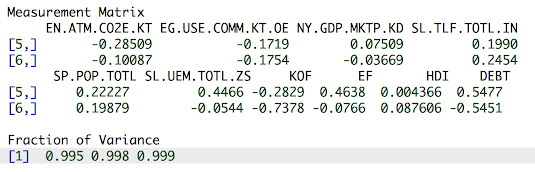
One question you might have is how important DEBT is to the French Economy. If we include DEBT in the Measurement Matrix (below) is doesn't become important until the Fifth and Sixth components and explains under 0.3% of the variation.


The two debt components, FR5 and FR6, capture the (DEBT+Unemployment+Ecological Footprint-KOF Globalization) and (L+KOF-DEBT) controllers, respectively.


The time plots of FR5 and FR6 (above) suggest that the two components are random walks being thrown around by shocks. To me, the results says that the Political System is mostly preoccupied with chaotic components that can be leveraged for political advantage. I discuss the future path of the FR dominant components here.

Notes

Q =  NY.GDP.MKTP.KD, DEBT = GC.DOD.TOTL.GD.ZS,  both from the World Development Indicators (WDI). All variables are in standard scores. The methodology used to create forecasts is similar to the one used by the Atlanta Federal Reserves GDPNow app. Prediction intervals are generated using a Bootstrap algorithm in the R programming language.

The FR1 state variable was created from the following weighted indicators (the first row of the Measurement Matrix) and explain 98% of the variation. 


The first six indicators are taken from the World Development Indicators (WDI). KOF = KOF Index of Globalization, EF = Ecological Footprint, HDI = Human Development Index. The second two components: FR2=(CO2+EF-KOF) and FR3 = (LU-L-N-HDI) describe environmental and Unemployment Error Correction Controllers (ECCs).

You can run the FRL20-BAU model here