State Space Models

All state space models are written and estimated in the R programming language. The models are available here with instructions and R procedures for manipulating the models here here.
Showing posts with label collapse. Show all posts

Thursday, October 9, 2025

World-System (1970-2150) Six Futures for Colombian Growth


The Trump II Administration's Gunboat Diplomacy in the Caribbean  has brought Colombia into the supposed War on Narco-trafficers. The BBC Reports (here) that

Colombian President Gustavo Petro has said that a boat recently bombed by the US was "Colombian with Colombian citizens inside", an allegation the White House called "baseless".

To provide some background to Trump's legally questionable military actions in International Waters, it would seem useful to understand the Economy of Colombia and how it might be affected by possible US military action. Google AI provides the following overview:


Colombia also has an historical reputation as a Cocaine Trafficker, but the Cocaine trade has recently been disrupted as a result of domestic and global forces that are reshaping the drug industry.

My first question, in this post, is what Geopolitical Alliances would be best for Colombia and how might Trump's Drug War affect the alliances. The graphic at the beginning of this post shows six "reasonable" future alignments for Colombia (some "unreasonable" futures are discussed below). Alignment with the US is cyclical and unstable, as is alignment with Russia (RU) and just continuing Business as Usual (BAU). Focusing on Globalization (KOF) provides the most stable future and is the best model from the standpoint of the AIC (see the Notes below, [23.47 < AIC = 51.86 < 81.82). Linkage with the World System (W) generates collapse starting around 2025.


There are a number of the collapse scenarios for Colombian Geopolitical Alignment (graphic above): Emphasis on Technical Efficiency (TECHE) and linkage with China (CN), the differences being when the collapse is forecast to start.


Notes


Google AI on the Economy of Columbia:


ChatGPT on Columbia Globalization:

 AIC Statistics:


Tuesday, September 30, 2025

World-System (1960-2100) Venezuela Growth Forecast

Venezuela is in the news right now for a number of reasons, mainly that the Trump Administration appears to be preparing an invasion. For the future, the VE20 model produces a rather wide range of overall growth forecasts (98% Bootstrap Prediction Interval on VE1) from exponential growth to collapse. 

The VE20 BAU Model is stable and will reach Steady State Economy sometime after 2100. For exponential growth or collapse to occur, the model would have to be destabilized, which might happen as a result of invasions or other external interference. An argument can be made that the approach Steady State Economy is part of the explanation for the ongoing  crises.

You can run the VE20 BAU model here and explore alternative futures.


Notes

Data are taken from the World Development Indicators (WDI). All variables are in standard scores. The methodology used to create forecasts is similar to the one used by the Atlanta Federal Reserves GDPNow app. Prediction intervals are generated using a Bootstrap algorithm in the R programming language (see the Boiler Plate).

You can run the VE20 Model here.

Measurement Model

The VE1 state variable is an overall weighting of all the indicators, VE2 is an Unemployment-GDP Controller and VE3 is an Environmental-Human Development vs. Emissions-Energy controller. The time plots are presented below.

VE20 BAU System Matrix


For the BAU model [147.6 < AIC = 167.2 < 182.8].

VE20 BAU Model Step-Ahead Predictions


The VE20 BAU model does a fairly good job of tracking the historical state variables except for turning points and during crisis periods, of which there are many.


Thursday, December 19, 2024

World-System (1980-2060) Five Futures for Russia (one surprised me)


Now that the Syrian Regime has collapsed (here), questions about what the collapse will mean for Russia are begin discussed (here). Russia did not intervene when rebels overran the Syrian capital and the question is "why" given that Syria fought not be become a Russian puppet state (a topic I will cover in a future post). In this post, I will concentrate on some possible future geopolitical alignments for Russia, one of which is to go it alone (BAU). One of the interesting and controversial models is to link to the EU, which would be by far the best choice for Russia, the least likely to happen in the medium term future and certainly the least discussed openly right now.

The graphic above presents five futures for Russia based on the RUL20 model (here):

  • BAU The Business As Usual model is unstable and cyclical (you can run the model yourself here). BAU is a fairly good model but not the best model (91.26 < AIC = 130.2 < 163.5). Unfortunately, the BAU model encourages military expansion because currently Russia needs Ukraine to prevent a Malthusian Population Crisis (to be covered in a future post).

  • RW The Random Walk model would be best interpreted as a descent into Chaos, today being like tomorrow except for random shocks. The RW is actually not a bad competitor model for Russia (110  < AIC =  128.9 < 147.3) and may be quite likely if Russia looses the War in Ukraine.

  • W Rather than isolating itself (BAU model), the World Linkage model assumes that Russia becomes an Open Society with Political and Economic links to all countries in the World-System (right now, Russia is a Semi-peripheral authoritarian country trying to become a Core country through military force). The W-Linkage model is not a very good competitor (126.4 < AIC = 155.6 < 190.1) and retains the unstable cyclical nature of the Russian System.

  • US Linking to the US has never been seriously pursued in Russia, although the Glasnost period in the 1980s is about as close as the two countries came (67.98 < AIC = 114.3 < 150.7)--maybe because it would lead to cyclical collapse for Russia. 

  • EU Russia joining the European Union (EU) is, to me (somewhat surprisingly), the best option (of the models considered here) for Russia (58.25  < AIC =  102.2 < 144). It would allow Russia to continue growing exponentially and benefit from trade with the EU (particularly oil, natural gas and agricultural trade with Ukraine). Maybe this dream scenario will happen at some time in the distant future, but I am not holding my breath.
There are certainly many other futures for Russia, but the graphic above seems to bracket the options from continued exponential growth to collapse. Let's just assume that Business as Usual with continued military expansion is, at least in the short run, the best prediction. To me, since the BAU model is cyclical and in the process of heading for a downturn (as of 2024), the best response would seem to be to keep supporting Ukraine and allow Russia to continue on the path of cyclical downturn. This does not seem to be the preferred path of the New Trump Administration in the US, starting in 2025.

Notes

Data taken from the World Development Indicators (WDI). All variables are in standard scores. The methodology used to create forecasts is similar to the one used by the Atlanta Federal Reserves GDPNow app. Prediction intervals are generated using a Bootstrap algorithm in the R programming language. The Akaike Information Criterion (AIC) is used for model selection.

You can run the RUL20 BAU Model here. You can change any coefficients in the System Matrix, F, to see what effect your changes will have on the system. Reasonable counterfactual values can be determined from the coefficient bootstrap confidence intervals:


LCI is the lower confidence interval and UCI is the upper confidence interval. In probability, the system can clearly be stabilized.

You can also run the EUL20 model here.

There is a small cottage industry of articles on Russia's Future many of them envisioning "Five" futures. Most of the articles are behind paywalls but here is one you can read from Casey Michel at The Atlantic Coouncil.

Monday, December 9, 2024

World-System (1970-2050) Five Futures for Syria


In a prior post (here) I presented one collapse scenario for Syria, now that the long standing Assad Regime has fallen. In this post, I will explore some alternatives (in the graphic above). A description of the SY20 model is provided below.

  • BAU The Business-as-Usual model is probably the best description of the Assad Regime. It was a unstable regime maintained by force. One fear about the collapse of the regime is that the future will be chaotic. Using the Akaike Information Criterion (AIC), the BAU model is one of the best models (-54.37 < AIC = -10.37 < 23.99) describing the SY20 system (see Notes below, the smaller the AIC, the better). 

  • US Diplomatic relations between Syria and the United States are currently "nonexistent". Syria was put on the State Sponsors of Terrorism list in 1979 and is the only country that has remained continuously on the list. From the period of the "War on Terror", the U.S. government has imposed a series of economic sanctions on Syria. After the government crackdown during the 2011 Syrian revolution; the US (alongside the European Union and Arab League) withdrew diplomatic recognition. The US has provided political, military and logistic support to the Syrian opposition. The new Syrian government might seek stronger linkages with the US, but the projections above are not very promising and somewhat unlikely (

    107.6 < AIC = 161.3 < 203.3).


  • RU Diplomatic relations between Russia and Syria have had, up to now, a long, friendly and stable history. Unfortunately for Bashar al-Assad (the current and now deposed president), Russia failed to defend the regime even though it had been providing military support up to the final coup. From the graphic above, the projection for Russia's support of Syria is cyclical and not much better than a Random Walk. The RU Puppet model, which Syria long resisted, would not be the best model for the future (97.65 < AIC = 162 < 219.9). Russia has it's own set of problems (not dissimilar to Syria) which I will cover in a future post.

  • RW The Random Walk model essentially makes no predictions about the future except that tomorrow will be like today with the addition of random error. Notice that it is not much different from either the US, RU or World models when taken as input. For the RW model (55.99 <  AIC = 95.64 < 125.5).

  • W Maybe somewhat surprisingly, linking Syria with the World System would not produce a result much better than a random walk (119.4 < AIC = 177.1 < 217.6). However, in World-Systems Theory, Syria is a Peripheral Country with weak institutions and a small share of World wealth. 

  • MEA The worst possible future for Syria is linkage with the MiddleEast-Africa. Projections indicate a severe collapse for the system (97.65 < AIC = 162 < 219.9).
In significant ways, these future projections for Syria do not capture the real problems for both Syria and Russia. In the Measurement Matrix, presented below, the primary feedback components for Syria are 1) Environmental (SY2 = 0.6926 EF - 0.4920 Energy Use) where EF is the Ecological Footprint and 2) Globalization induced unemployment (SY3 = 0.8838 LU - 0.363 KOF) where KOF is an index of globalization. I will cover these issues in future posts.

Notes


The SY1 state variable is a relatively equal weighting of six indicators from the World Development Database plus the KOF Index of Globalization, the Ecological Footprint (EF) and the UN Human Development Index (HDI). The FR2 index is (EF - EnergyUse) and the FR3 index is (Unemployment-Globalization) error correcting controllers (ECC), respectively. The major component creating the collapse in Syria is FR2, the environmental component. It should come as no surprise that Syria is in environmental crisis (here).

The SY20 model has no indicators describing the now-collapsed Syrian dictatorship so the future will be dominated by continuing environmental problems and globalization-driven unemployment. A government of rebel commanders is unlikely to address any of the issues that led to collapse

The SY20 model also does not capture trade relations, particularly with Russia (a vital supplier of essential commodities). I will cover Syrian Trade in a future post.

You can run the SY20 BAU model here. The model is unstable (see the System Matrix below).


You can stabilize the system by setting F[2,2]=1.012095084 to some number < 1.0 but greater than zero and rerunning the model. What results to you observe?

To give you a brief idea of what the Syrian Battle Space was like (a mess) here is a map from 2021.


Sunday, December 8, 2024

Word-System (2000-2100) Collapse of Syria

The New York Times (here) is reporting that the Syrian government has collapsed and the country has been overrun by rebel forces. The NYT is also saying that predicting Syria's future is challenging "...as the government’s sudden demise took many people who have watched the region for years by surprise." 

It must be the timing of the collapse that is surprising (as is often the case with dictatorships). The collapse itself was predictable, as can be seen from the graphic above. The SY20 model is based on data up to 2010 and predicts system collapse after 2040, so the current collapse is a little premature but still predictable.

Notes


The SY1 state variable is a relatively equal weighting of six indicators from the World Development Database plus the KOF Index of Globalization, the Ecological Footprint (EF) and the UN Human Development Index (HDI). The FR2 index is (EF - EnergyUse) and the FR3 index is (Unemployment-Globalization) error correcting controllers (ECC), respectively. The major component creating the collapse in Syria is FR2, the environmental component. It should come as no surprise that Syria is in environmental crisis (here).

The SY20 model has no indicators describing the now-collapsed Syrian dictatorship so the future will be dominated by continuing environmental problems and globalization-driven unemployment. A government of rebel commanders is unlikely to address any of the issues that led to collapse.

You can run the SY20 BAU model here.

Thursday, December 5, 2024

World-System (1980-2100) Six Futures for France

The New York Times (here) is reporting that the recent collapse of the French government will "...further burden its weak economy" and have ripple effects across Europe. The analysis, however, might be confusing cause and effect. Weakness in the European Union (EU) economies, to include France, might be creating the observed political instability. What I want to explore, starting with France, is whether we are observing the emergence of Steady State Economies in the EU, and that this should not be confused with "weakness". Business commentators and economists, at least in the US, seem convinced that economies can grow forever or, at least, for the foreseeable future. For example, the DICE model (a neoclassical integrated assessment model) grows forever unless a limit is put on technological change. So, it is no surprise that the FR20 (France Twentieth Century model, the dashed blue line marked FR) driven by the US Economy grows forever (dashed red line marked US in the graphic above). Unfortunately, for neoclassical economic theory, this is not the best description of the current French economy using the Akaike Information Criterion (AIC).

Three other models, the Random Walk (RW, dashed blue), the Business As Usual (BAU, black line) and the EU model (right beneath it) are probably what classical economists would identify as the Steady State Economy. Growth reaches an asymptote around 2100. Finally, the FR20 model is driven into collapse mode by the World System (dotted green line).

If you prefer central tendencies in your forecasts, then you probably would conclude that the Steady State Economy is the most likely future. If you are a techno-optimist, you will probably prefer the US-driven future. If you are a Degrowth advocate, you will probably prefer the FR or the W scenario.

Without committing myself to some unknowable future, it seems clear to me that the steady-state and collapse scenarios will not be accepted without resistance. Demonstrators will take to the streets, governments will fall, right-wing political groups will grow in appeal and we will enter a period of chaos. Maybe this is why the Infinite-growth scenario is so appealing.


Notes

FR1 is the dominant state variable of the FR20 system with data taken from the World Development Indicators (WDI). The methodology used to create forecasts is similar to the one used by the Atlanta Federal Reserves GDPNow app. Prediction intervals are generated using a Bootstrap algorithm in the R programming language.

The FR1 state variable was created from the following weighted indicators (the first row of the Measurement Matrix) and explain 98% of the variation. 


The first six indicators in standard scores are taken from the World Development Indicators (WDI). KOF = KOF Index of Globalization, EF = Ecological Footprint, HDI = Human Development Index. The second two components: FR2=(CO2+EF-KOF) and FR3 = (LU-L-N-HDI) describe environmental and Unemployment Error Correction Controllers (ECCs).

You can run the FRL20-BAU model here. 

Wednesday, December 4, 2024

French Debt, Collapse of the Government and COVID-19, World-System (1950-Present)


Le Monde (here) is reporting that, after a vote of no-confidence, the coalition government of Emmanuel Macron is about to collapse. Earlier this Summer, Macron had called snap elections in which he did not get enough votes to retain power without forming the coalition government. Now that government has fallen, supposedly over the problem of Central Government Debt.

The graphic above displays the shocks to the (Q-DEBT) error-correction controller that triggered the collapse. The 2020 COVID-19 shock initially decreased (Q-DEBT) as the economy contracted, but after that DEBT increased dramatically to deal with COVID-19 and stimulate the economy. The effects of the COVID-19 shocks are still with us even though the media seems not to highlight the connection.


Debt has been a problem in the European Union (EU) since the  European Sovereign Debt Crisis from 2010 through 2024 (which can also be seen clearly in the graphic at the beginning of this post). Debt is a problem in the EU since states do not control their own currency and cannot print Euros when needed. Modern Monetary Theory (MMT) suggests that the Euro-zone single currency is at the root of the problem. 

If the currency-inflexibility problem is not resolved, the forecast for (Q-DEBT) in the graphic above is for increasing problems, especially when future shocks create instability.

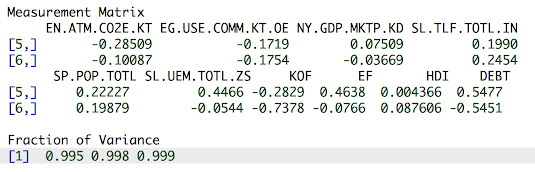
One question you might have is how important DEBT is to the French Economy. If we include DEBT in the Measurement Matrix (below) is doesn't become important until the Fifth and Sixth components and explains under 0.3% of the variation.


The two debt components, FR5 and FR6, capture the (DEBT+Unemployment+Ecological Footprint-KOF Globalization) and (L+KOF-DEBT) controllers, respectively.


The time plots of FR5 and FR6 (above) suggest that the two components are random walks being thrown around by shocks. To me, the results says that the Political System is mostly preoccupied with chaotic components that can be leveraged for political advantage. I discuss the future path of the FR dominant components here.

Notes

Q =  NY.GDP.MKTP.KD, DEBT = GC.DOD.TOTL.GD.ZS,  both from the World Development Indicators (WDI). All variables are in standard scores. The methodology used to create forecasts is similar to the one used by the Atlanta Federal Reserves GDPNow app. Prediction intervals are generated using a Bootstrap algorithm in the R programming language.

The FR1 state variable was created from the following weighted indicators (the first row of the Measurement Matrix) and explain 98% of the variation. 


The first six indicators are taken from the World Development Indicators (WDI). KOF = KOF Index of Globalization, EF = Ecological Footprint, HDI = Human Development Index. The second two components: FR2=(CO2+EF-KOF) and FR3 = (LU-L-N-HDI) describe environmental and Unemployment Error Correction Controllers (ECCs).

You can run the FRL20-BAU model here.